Migraine Headaches
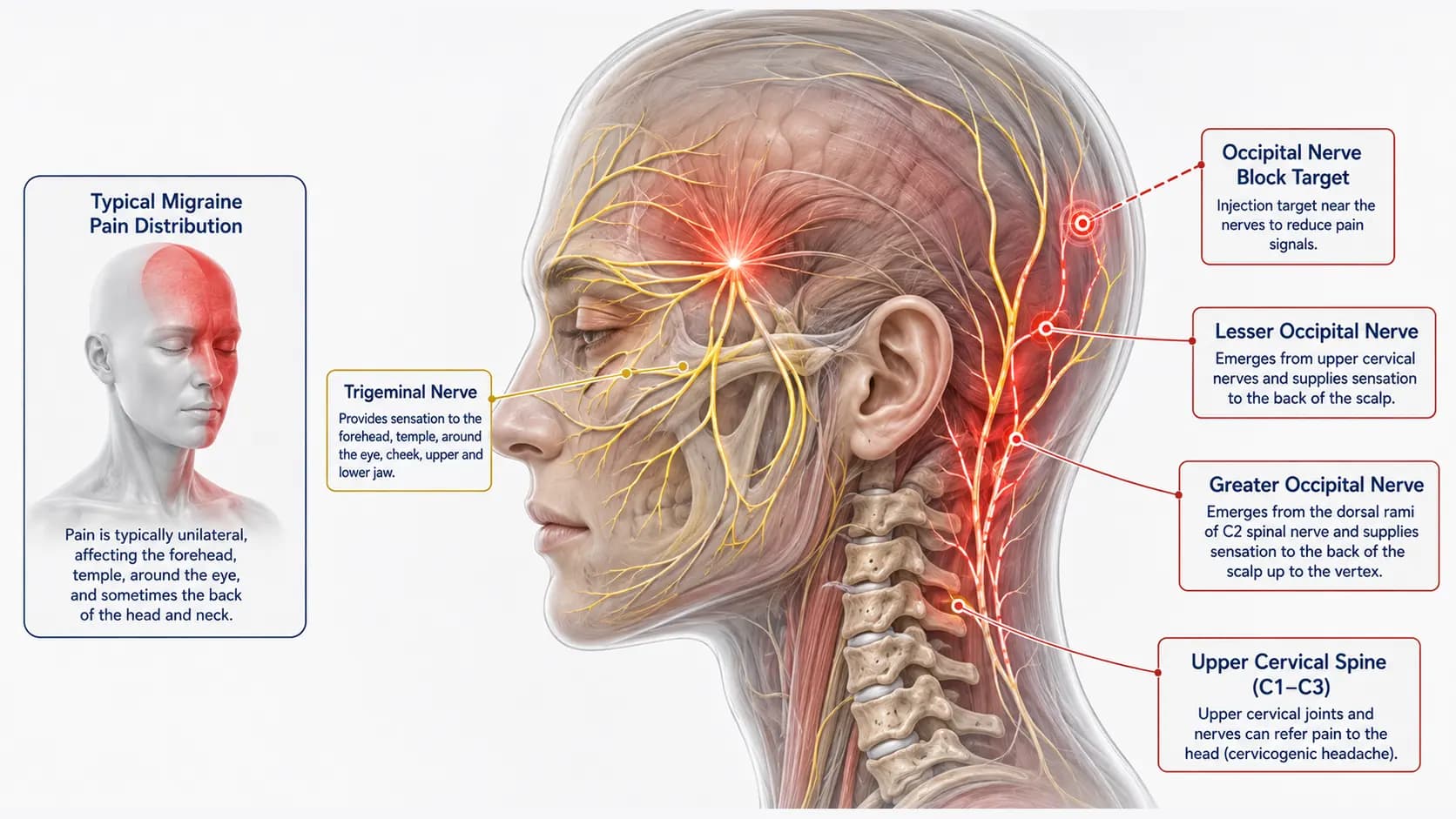
Migraines are recurrent, often one-sided headaches with sensitivity to light, sound, and sometimes nausea. When cervical spine dysfunction or nerve irritation contribute to your migraines, interventional treatment of those structures may reduce your pain.
We identify whether your migraines involve structural or myofascial contributors — occipital nerve irritation, cervical pathology, or muscle trigger points — and treat what we find while you continue your primary care with neurology.
Diagnosis-first care for migraine headaches
Physician-led evaluation, image-guided procedures when indicated, and insurance-friendly scheduling across three Houston-area clinics.
Understanding migraine headaches
Migraines are a neurological condition characterized by recurrent, often severe headaches accompanied by sensitivity to light, sound, and sometimes nausea or vomiting. While the underlying migraine mechanism is complex and managed by neurology, certain patients also have structural contributors in the cervical spine or myofascial tension that amplify their pain or trigger attacks.
Cervical dysfunction, occipital nerve irritation, and myofascial tension in the neck and shoulders can coexist with and worsen primary migraines. Identifying these structural factors is important because treating them precisely may provide the additional relief that standard medical management alone has not achieved.
Primary migraine management rests with neurology. Our role is to evaluate whether cervical pathology, muscular trigger points, or occipital nerve involvement are playing a significant part in your migraines, and if so, to treat them. We work alongside your neurologist toward better outcomes.
Many patients experience breakthrough migraines despite medical management, or notice that neck symptoms accompany their headaches. Evaluation can clarify whether structural factors are involved.
- Sudden change in migraine pattern, frequency, or severity
- New headache accompanied by fever, stiff neck, or confusion
- Headache following head or neck injury
- Migraines refractory to standard preventive and acute medications
What patients usually describe
- Throbbing or pulsating pain on one side of the head
- Sensitivity to light, sound, or smell during attacks
- Nausea or vomiting
- Neck pain or stiffness coinciding with or preceding headaches
- Pain triggered or worsened by neck movement
- Visual disturbance or aura prior to headache onset
What we look for in evaluation
- Neurological migraine mechanisms, complex and incompletely understood
- Cervical spine dysfunction contributing to or triggering migraines
- Myofascial trigger points in neck and shoulder muscles
- Occipital nerve irritation or compression
- Cervicogenic factors — migraines secondary to cervical pathology
Diagnosis comes before any procedure.
We assess your migraine history, perform cervical range-of-motion testing, and palpate the cervical spine and associated muscles for tender points, restriction, and signs of dysfunction. Occipital nerve tenderness is evaluated. Imaging such as MRI may help if cervical pathology is suspected.
Detailed migraine history, cervical examination, palpation for trigger points and nerve irritation.
Determine whether cervical dysfunction, myofascial tension, or nerve irritation are contributing to your migraines.
Targeted interventional treatment of structural factors, coordinated with your neurologist's medical management.
Treatments we offer for migraine headaches
Each option below is matched to a confirmed pain generator. We start with the least invasive effective approach and only escalate when the diagnosis supports it.
Your first appointment
Expect a thorough migraine history, careful cervical examination, and palpation to identify structural contributions. We discuss which factors are likely playing a role and what interventional treatment can realistically address.
What recovery typically looks like
Response varies. Some patients notice improvement after a single injection; others benefit from a series of treatments. Your neurologist continues guiding your overall migraine strategy; we focus on the structural elements within our scope.
Conditions patients with migraine headaches often ask about
Questions about migraine headaches
Can you cure my migraines?
No. Migraines are a complex neurological condition without a cure. However, when cervical and myofascial factors are contributing, treating them can substantially reduce frequency and severity for many patients.
Do I need a referral to schedule an appointment?
Yes. A referral from your current healthcare provider is required for your first visit.
Will your treatment replace my migraine medications?
No. Interventional treatment of structural contributors works alongside your neurologist's medical management. Both approaches work together toward better control.
Ready to find the source of your pain?
Share a few details and our team will reach out to confirm a time that works with your schedule and your insurance.
Request an appointment
Tell us about your migraine headaches symptoms and preferred clinic. We will confirm the next available appointment options.