Fibromyalgia and Myofascial Pain
Fibromyalgia and myofascial pain syndrome are related but distinct conditions that produce widespread or regional muscle pain, often accompanied by fatigue, sleep disturbance, and tender points or trigger points that respond differently to treatment.
Our evaluation distinguishes between these conditions so the treatment plan addresses the underlying mechanism — whether central sensitization requires multimodal care or regional trigger points can benefit from precise interventional injections.
Diagnosis-first care for fibromyalgia and myofascial pain
Physician-led evaluation, image-guided procedures when indicated, and insurance-friendly scheduling across three Houston-area clinics.
Understanding fibromyalgia and myofascial pain
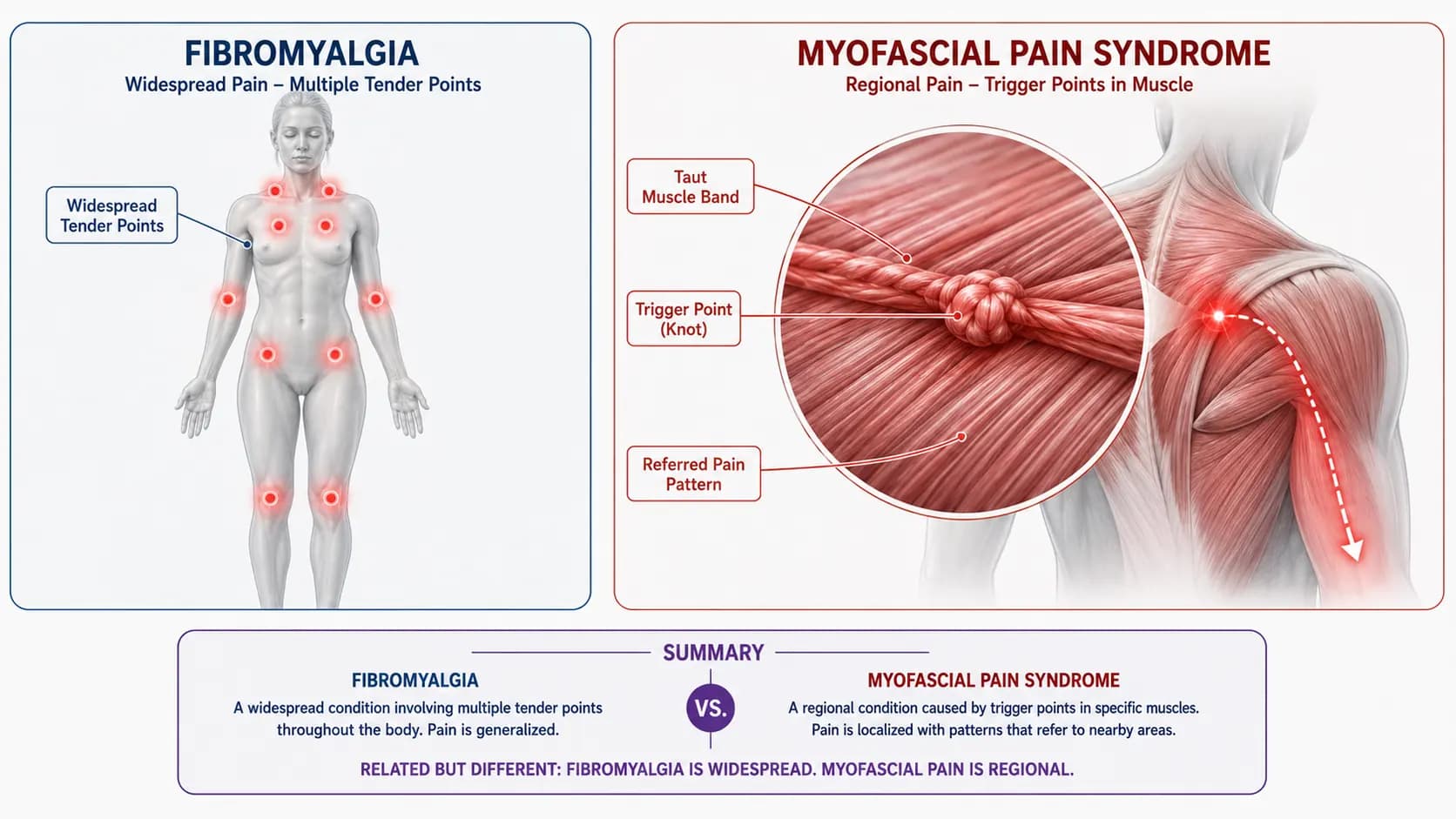
Fibromyalgia is a disorder of central sensitization characterized by widespread musculoskeletal pain, fatigue, sleep disturbance, and cognitive symptoms that reflect altered pain processing in the nervous system rather than local tissue injury. Myofascial pain syndrome, by contrast, is a regional disorder driven by trigger points — hyperirritable spots in specific muscles — that produce localized or referred pain patterns. These conditions overlap clinically but require different treatment approaches.
In fibromyalgia, pain arises from amplified central nervous system signaling rather than inflammation at specific sites, making it primarily a problem for coordinated multimodal management involving sleep hygiene, exercise, stress reduction, and sometimes medication. In myofascial pain, treatment can target the underlying trigger points directly through injection or manual therapies. Both conditions may coexist in the same patient, which complicates evaluation but also clarifies the pathway forward.
Interventional procedures — particularly trigger point injections — are effective for myofascial pain syndrome and can provide relief in regional components of fibromyalgia. However, fibromyalgia as a primary diagnosis is managed best through a coordinated approach that may include rheumatology or primary care, with interventional care playing an adjunctive role in addressing secondary muscle pain and tension.
Most muscle pain improves with rest, stretching, and activity. However, pain that persists for more than a few weeks, significantly limits function, or fails to respond to conservative care warrants evaluation to distinguish between myofascial and fibromyalgia mechanisms.
- Pain that worsens rapidly or spreads to new areas
- Severe weakness or loss of function in an arm or leg
- Pain accompanied by fever, unexplained weight loss, or systemic symptoms
- Progressive symptoms unresponsive to rest and gentle stretching after several weeks
What patients usually describe
- Widespread or localized muscle pain and achiness
- Trigger points — tender, hypersensitive areas in muscle tissue
- Fatigue and low energy, especially in fibromyalgia
- Sleep disturbance or unrefreshing sleep
- Referred pain patterns from trigger points
- Morning stiffness or muscle tightness
- Cognitive symptoms such as difficulty concentrating (fibromyalgia)
What we look for in evaluation
- In myofascial pain: overuse, muscle injury, poor posture, or sustained tension in specific muscle groups
- In fibromyalgia: central sensitization — altered pain processing in the nervous system — often triggered by physical or emotional stress, infection, or injury
- Repetitive strain or occupational stress
- Underlying spine or joint pathology that triggers secondary muscle guarding
- Deconditioning or sedentary lifestyle
- Sleep disturbance and stress in fibromyalgia
Diagnosis comes before any procedure.
The exam identifies specific trigger points and maps referred pain patterns typical of myofascial syndrome. For widespread pain, we assess for fibromyalgia criteria — sleep quality, fatigue, cognitive symptoms — and coordinate with your primary care or rheumatology provider. Imaging such as ultrasound can confirm muscle tension and guide injection placement when myofascial pain is regional.
Physical exam to localize trigger points, palpate muscles, and identify pain referral patterns.
Differentiate regional myofascial pain from widespread fibromyalgia through symptom pattern and clinical findings.
If myofascial: targeted injections to trigger points. If fibromyalgia: adjunctive injections combined with multimodal management coordinated with your primary provider.
Treatments we offer for fibromyalgia and myofascial pain
Each option below is matched to a confirmed pain generator. We start with the least invasive effective approach and only escalate when the diagnosis supports it.
Your first appointment
Expect a thorough history focused on pain location, triggers, and activity level, followed by a detailed physical exam to identify trigger points and referred pain patterns. We will clarify whether your pain is primarily myofascial, fibromyalgia, or a combination, and explain how interventional care fits into your overall treatment plan.
What recovery typically looks like
Myofascial pain often improves significantly within one to two weeks after trigger point injection, especially when combined with stretching and activity. Fibromyalgia requires longer-term multimodal management; injections can address painful regional components but are not a standalone treatment. Most patients benefit from ongoing coordination with their primary care or rheumatology provider.
Conditions patients with fibromyalgia and myofascial pain often ask about
Questions about fibromyalgia and myofascial pain
Are fibromyalgia and myofascial pain syndrome the same thing?
No. Fibromyalgia is widespread and driven by altered pain processing in the nervous system, while myofascial pain is regional and driven by trigger points in specific muscles. They can coexist, but they are distinct conditions requiring different approaches to treatment.
Can trigger point injections cure fibromyalgia?
Trigger point injections can relieve regional muscle pain and tender points in fibromyalgia, but they are not a cure. Fibromyalgia management is primarily multimodal — sleep, exercise, stress reduction, and medication — often coordinated with your rheumatologist or primary care provider.
How quickly do trigger point injections work?
Many patients with myofascial pain notice improvement within one to two weeks. Pain relief supports continued activity and stretching, which help prevent recurrence.
Ready to find the source of your pain?
Share a few details and our team will reach out to confirm a time that works with your schedule and your insurance.
Request an appointment
Tell us about your fibromyalgia and myofascial pain symptoms and preferred clinic. We will confirm the next available appointment options.