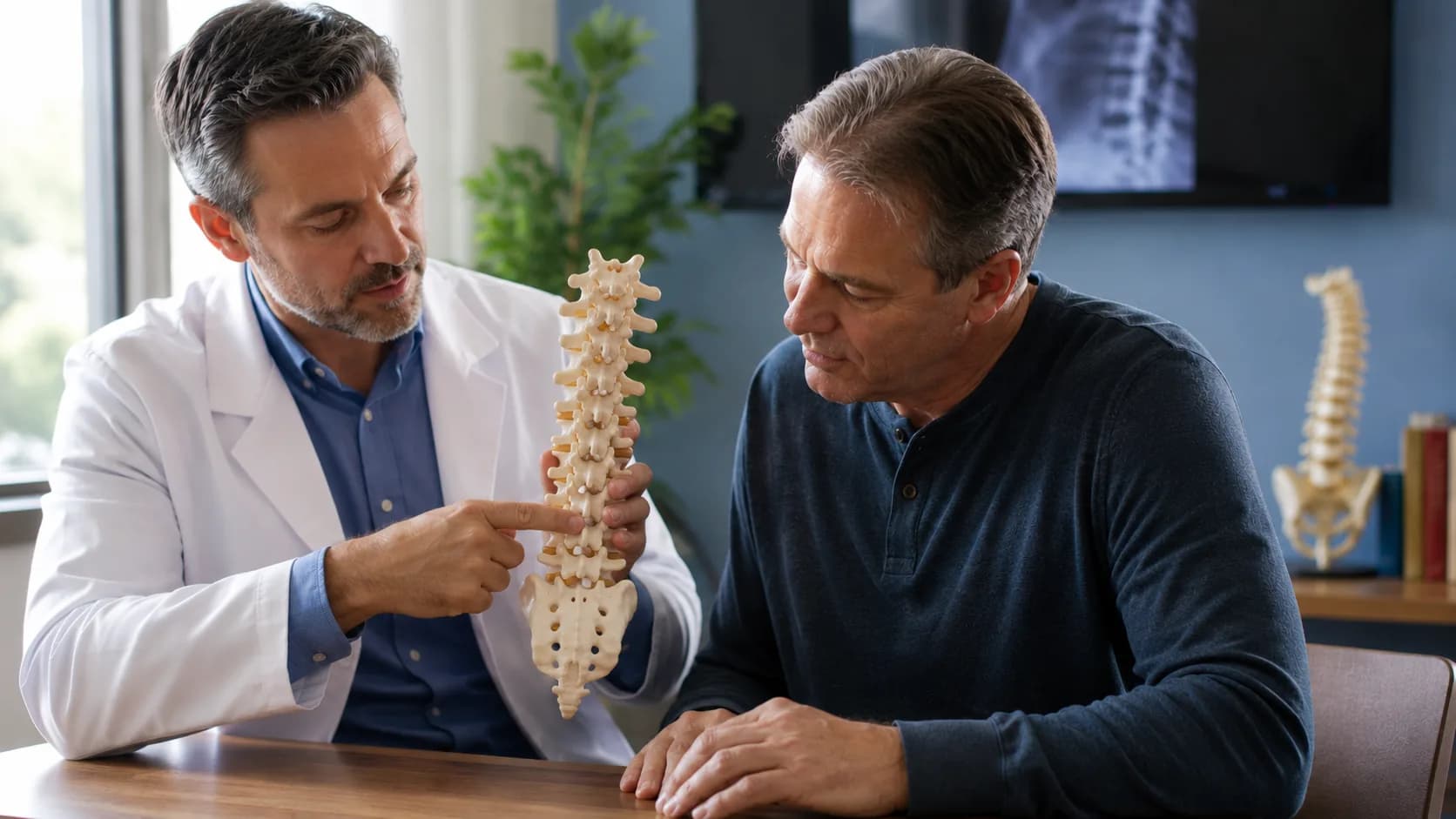
When most patients think about back pain, they think about discs. Discs are important, but they are not the only structure in the spine that can hurt. The facet joints — the small paired joints that connect each vertebra to the one above and below — are a major source of chronic neck and low back pain that is often missed in primary care. Estimates from the interventional pain literature suggest that facet joints contribute to chronic low back pain in roughly 15 to 45 percent of patients, with the percentage rising in older adults and in patients with degenerative changes.
The good news is that facet pain is one of the most treatable patterns in interventional pain medicine. When the diagnosis is made carefully and the right procedural approach is used, most patients achieve substantial relief without surgery and without opioids.
What facet joints do — and why they hurt
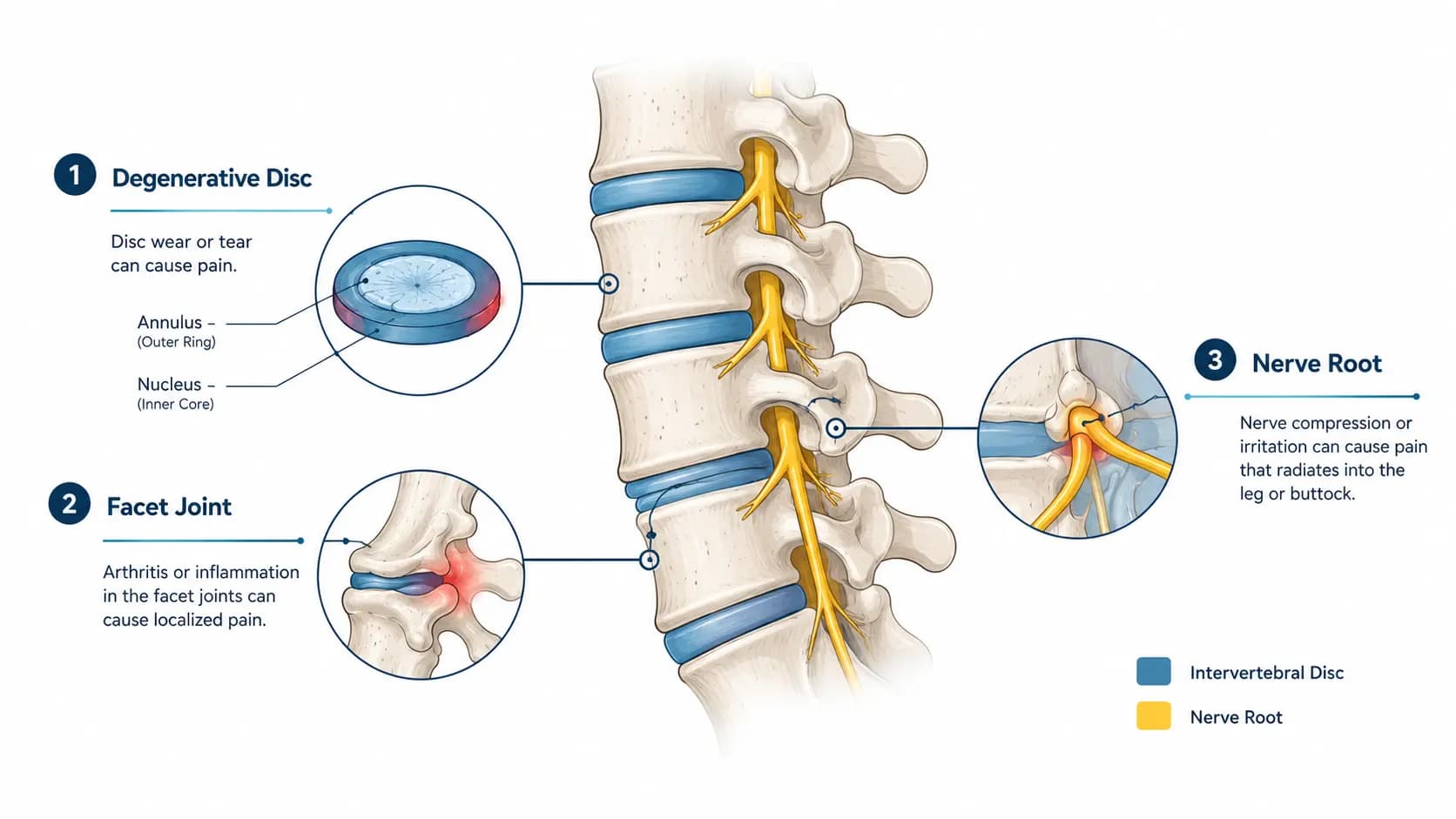
Each level of the spine has two facet joints, one on each side. They are true synovial joints, lined with cartilage and a thin joint capsule, and they guide and limit how the spine moves. Like every other joint in the body, facet joints can develop osteoarthritis, capsular inflammation, and pain-producing changes over time. Repetitive strain, prior injury, and the simple effects of age all play a role.
The classic clinical pattern is axial pain — pain that sits in the low back or neck rather than radiating down a leg or arm. It tends to worsen with extension, rotation, or transitions like standing up from a seated position, and to ease with sitting or bending slightly forward. Most patients can localize the discomfort with one or two fingers, often paraspinal and not in the midline. Imaging may show facet arthritis, but imaging alone cannot tell you whether the facet joints are actually generating pain — many people have facet changes on MRI without any back pain at all.
Diagnosis — why diagnostic blocks matter
The most accurate way to determine whether the facet joints are the pain generator is a diagnostic medial branch block. The small medial branch nerves carry pain signals from each facet joint to the central nervous system. By temporarily numbing those specific nerves with a small dose of local anesthetic, your physician can see whether your usual pain disappears. Significant short-term relief after a properly performed block is strong evidence that the facet joints are responsible.
Because each facet joint is innervated by two medial branches, the blocks are performed at multiple levels to cover the joint of interest. Many specialists perform two confirmatory blocks before proceeding with longer-term treatment — this dual-block approach reduces the chance of a false positive and is consistent with the most rigorous published protocols. It also gives patients a useful preview of what fuller treatment might feel like.
Treatment options once the diagnosis is clear
If diagnostic blocks confirm that the facet joints are the pain generator, the conversation shifts to which treatment is most likely to provide durable relief. For many patients, the next step is radiofrequency ablation of the same medial branch nerves that were blocked. Recent comparative studies from major academic centers have shown that medial branch interventions can provide meaningful relief at six months and beyond in carefully selected patients.
Intra-articular corticosteroid injections directly into the facet joint are another option, particularly when there is significant joint inflammation. The evidence supports both intra-articular injections and medial branch interventions, and the right choice depends on your specific anatomy, prior treatments, and clinical pattern. A thoughtful interventional pain specialist will explain why one approach is being recommended over the other in your case rather than offering a generic protocol.
“The most important question in a facet pain workup is not which procedure to do. It is whether the facet joints are actually what is hurting in the first place. That is what diagnostic blocks are for.”
Why physical therapy still matters
Even when interventional treatment is highly effective, it is not the whole story. Facet pain almost always coexists with deconditioning of the deep stabilizers of the spine — the multifidus, transverse abdominis, and pelvic floor — and with tightness through the hips and thoracic spine. A focused course of physical therapy following an effective intervention typically produces longer relief than the procedure alone.
Strength and mobility work also protect against re-aggravating the joints. Patients who pair an effective procedure with consistent exercise tend to keep their gains the longest, and many can stretch the interval between procedures considerably. This is the same multimodal logic that drives modern, non-opioid pain care across the board.
When to consider an evaluation
Chronic axial back or neck pain that has not improved after several weeks of conservative care, that worsens with extension or rotation, and that is interfering with your work, sleep, or daily activity is worth a focused evaluation. A good pain specialist will not promise a procedure on the first visit. They will examine you carefully, review your imaging, and recommend the smallest, most targeted next step — which is often a diagnostic block, sometimes simply a structured course of therapy first.
Interventional Pain Management performs diagnostic facet workups, medial branch blocks, intra-articular facet injections, and radiofrequency ablation across our Pasadena, Baytown, and Katy clinics. Call 713.369.1969 or request an appointment online to schedule an evaluation and find out whether your facet joints are part of the picture.