
Sciatica is one of the most common reasons adults consult a pain specialist, and also one of the most misunderstood. Patients often arrive convinced they need surgery, when in reality the great majority of sciatica cases resolve without an operation. Reviews of conservative and interventional treatments consistently show that 80 to 90 percent of patients improve with a combination of physical therapy, targeted medication, and image-guided injections when those are needed. Surgery has a clear role, but it is rarely the first step.
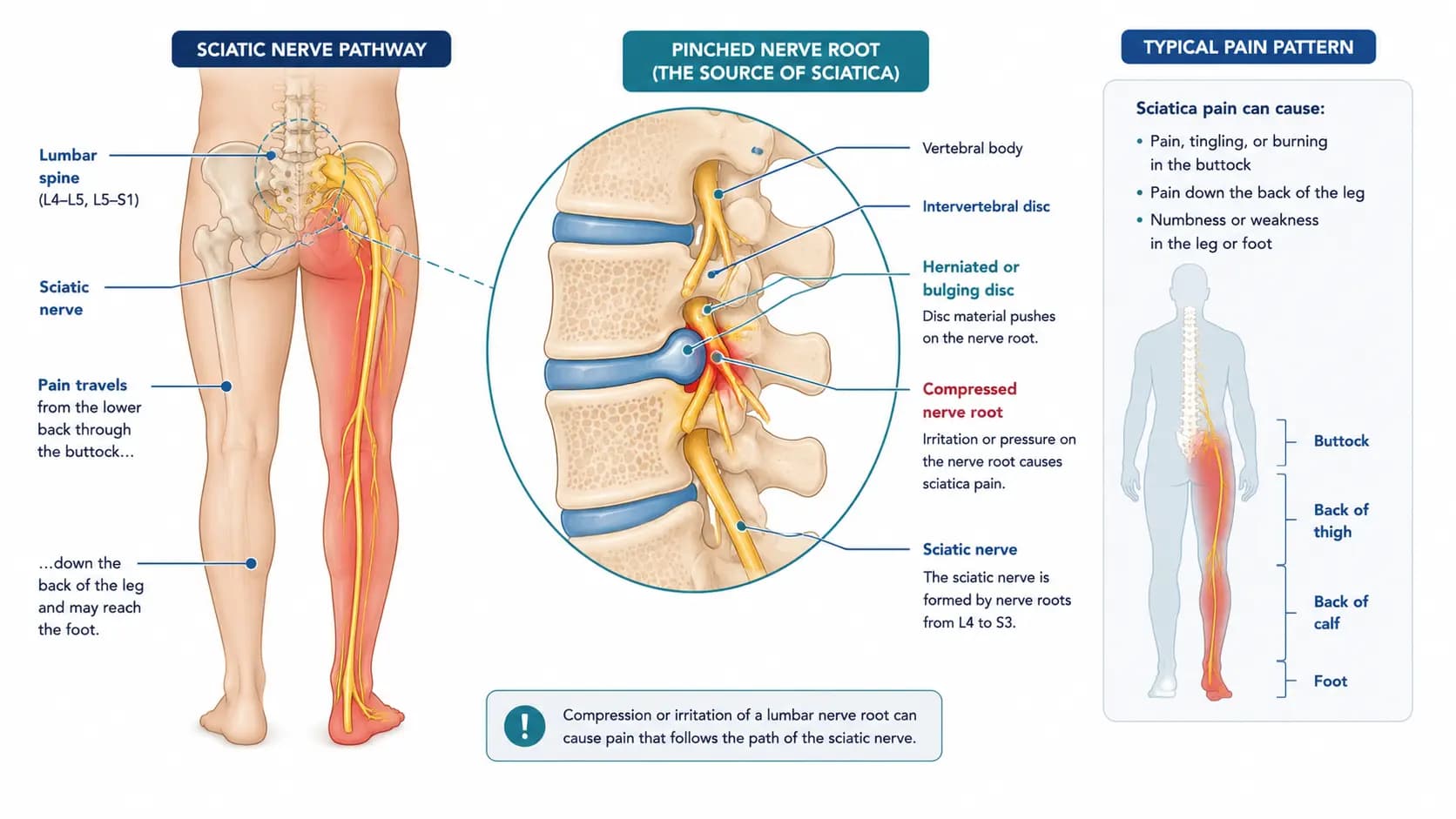
The first thing a pain specialist does is replace the word "sciatica" with a specific anatomic diagnosis. Sciatica simply means leg pain that travels along the path of the sciatic nerve, usually from the low back down through the buttock and into the leg. Several different problems can produce that pattern, and the treatment plan looks very different depending on which one is responsible.
What is actually causing the pain
The most common driver of sciatica is a lumbar disc herniation. When the soft inner portion of a spinal disc pushes against a nerve root, it can produce the classic sharp, burning, electric pain that travels down the leg. Imaging often shows the herniated disc, but not every visible herniation actually causes pain — your clinical exam matters as much as the MRI.
Spinal stenosis is another common cause, particularly in patients over 60. Here, age-related narrowing of the spinal canal puts pressure on the nerve roots, and the classic symptom is leg pain that worsens with standing or walking and improves with sitting or leaning forward on a shopping cart. Piriformis syndrome, sacroiliac joint dysfunction, and facet-related referred pain can all mimic sciatica as well. A skilled examination, combined with imaging when appropriate, is what tells these apart.
First-line conservative care
Most patients do best when treatment starts with the least invasive option that has a reasonable chance of working. That usually means a brief course of anti-inflammatory medication, structured physical therapy focused on the lumbar spine and hip, and education on movement and posture. Physical therapy is not just stretching — a good program rebuilds the deep stabilizers of the lumbar spine and teaches you how to move without triggering the nerve.
Heat, ice, and short-term over-the-counter medications are reasonable adjuncts. We will sometimes add a neuropathic medication such as gabapentin or duloxetine when the pain is clearly nerve-related and is disrupting sleep. Opioids are not part of routine sciatica care. They can mask the problem without addressing the underlying nerve irritation and are generally not necessary when an interventional plan is available.
When interventional treatment is the right next step
If structured conservative care is not getting you back to your normal activity within a few weeks, or if the pain is severe enough to prevent that care from happening at all, image-guided injections become a powerful option. An epidural steroid injection is the most common — a small dose of corticosteroid delivered with fluoroscopic guidance directly to the inflamed nerve root. Recent systematic reviews show meaningful reductions in leg pain and improvements in function in the weeks following the procedure, particularly when there is a clear contact between a herniated disc and a specific nerve root.
When the pain is coming from a single nerve root or a specific facet joint, a diagnostic selective nerve root block or medial branch block can both confirm the pain generator and provide therapeutic relief. The point of a diagnostic block is to be specific — relief after a targeted injection tells us that we are treating the right structure, which sharpens every subsequent step of the plan.
“A targeted injection is not a long-term solution by itself. The goal is to lower the pain enough that you can do the work in physical therapy that produces durable change.”
Longer-lasting nerve treatments
For patients whose pain is driven by chronic irritation of the facet joints or who have ongoing radiating pain after surgery, radiofrequency ablation can offer six to twelve months — sometimes longer — of relief by quieting the small medial branch nerves that carry the pain signal. Spinal cord stimulation is reserved for a different group of patients: those with persistent radiating leg pain after spine surgery, or with complex regional pain syndrome, whose symptoms have not responded to other treatments. A trial period lets you experience the device before any permanent implant.
Regenerative options such as platelet-rich plasma are sometimes appropriate, particularly when an inflamed sacroiliac joint or tendon is part of the picture. These should be discussed honestly: the evidence for regenerative injections in true radicular sciatica is still developing, and they are best considered as one tool inside a broader plan rather than a stand-alone fix.
When surgery genuinely makes sense
Surgery has clear indications, even though it is not the first step. Progressive weakness in the leg, a sudden loss of bowel or bladder control, or pain that does not improve after a serious trial of conservative and interventional care can all justify a surgical consultation. The role of a pain specialist is not to talk patients out of surgery — it is to make sure surgery happens only when it is the right answer, and to manage the spectrum of options that lie between physical therapy and the operating room.
If you are dealing with leg pain that won't go away, the most useful next step is an honest evaluation: where exactly is the pain coming from, what have you tried, and what is realistic from here. Interventional Pain Management cares for patients with sciatica across Pasadena, Baytown, and Katy, and most plans involve more steps than surgery and fewer than you might fear. Call 713.369.1969 or request an appointment online to start that conversation.