Phantom Limb Pain
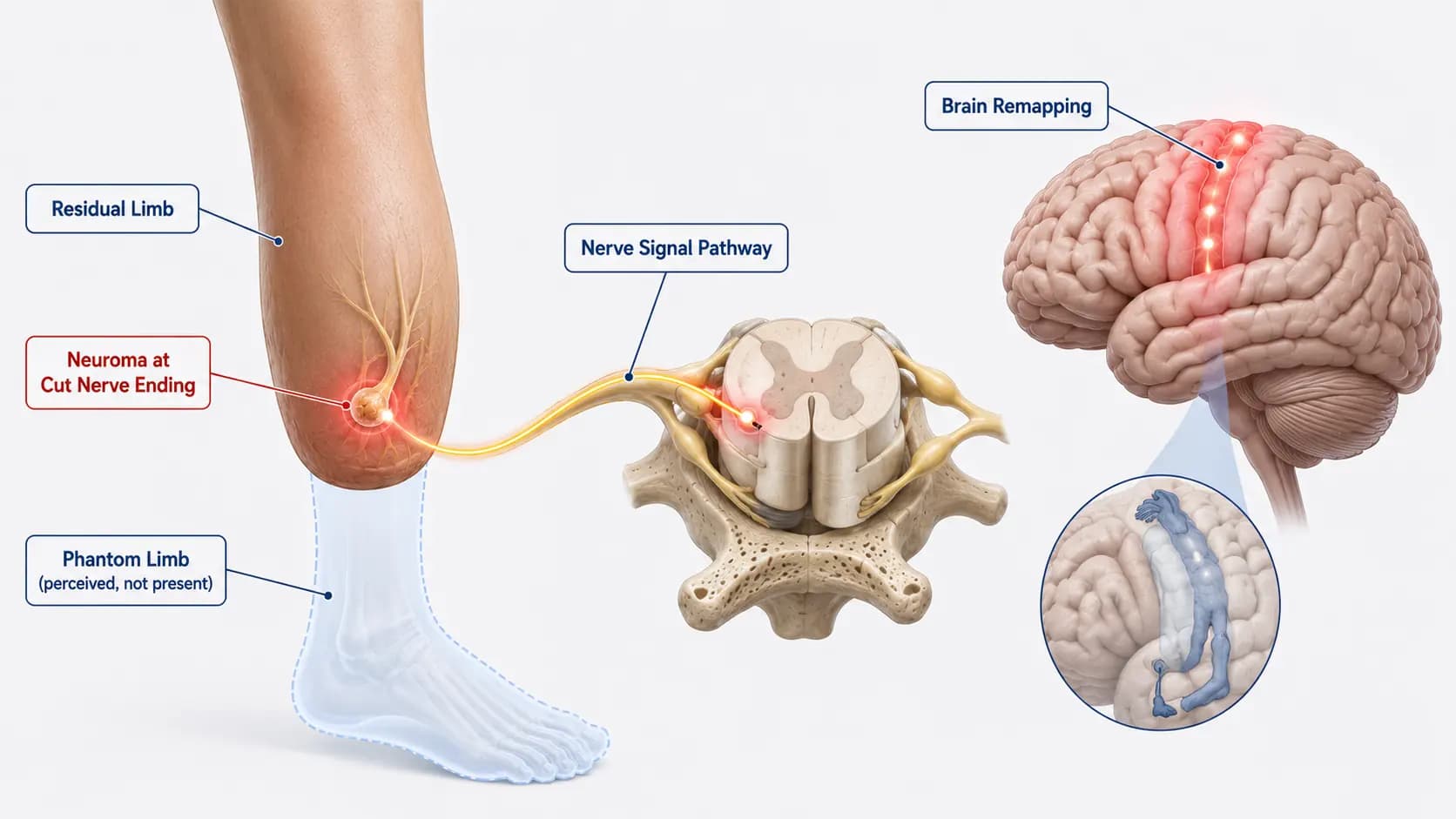
Phantom limb pain is real, genuine pain felt in a limb that is no longer present, arising from complex changes in the peripheral nerves, spinal cord, and brain after amputation.
Our evaluation distinguishes phantom pain from phantom sensation and residual limb pain so that treatment targets the correct mechanism.
Diagnosis-first care for phantom limb pain
Physician-led evaluation, image-guided procedures when indicated, and insurance-friendly scheduling across three Houston-area clinics.
Understanding phantom limb pain
Phantom limb pain is genuine pain perceived in an amputated limb and is not imagined or psychological. It arises from changes in the peripheral nerves at the amputation site, reorganization in the spinal cord, and remapping in the brain's motor and sensory cortex. The brain retains the neural map of the missing limb and interprets certain signals as pain.
Phantom limb pain is distinct from phantom sensation, which is the non-painful awareness or feeling that the limb is still present. It is also separate from residual limb or stump pain, which occurs in the remaining portion of the limb and is often related to neuroma formation, scar tissue, or the fit and pressure of a prosthetic. A patient may experience any or all three.
Successful management is multimodal and coordinated across physical medicine, rehabilitation, prosthetics, and pain medicine. Mirror therapy, progressive prosthetic use, physical reconditioning, medication, and interventional nerve procedures work together to reduce pain and restore function. Care typically combines these approaches rather than relying on any single treatment.
Phantom limb pain often begins within weeks of amputation. Early, proactive evaluation and coordinated multimodal care provide the best outcomes and prevent progression to chronic, resistant pain.
- Pain in the phantom limb preventing sleep or rehabilitation participation
- Pain that escalates despite prosthetic use and physical therapy
- Functional decline or isolation due to pain severity
- Symptoms that develop later after initial pain-free period
What patients usually describe
- Pain in the location of the missing limb
- Tingling, burning, or electric sensations in the phantom limb
- Cramping or pressure in the missing limb
- Pain that worsens with weather changes, emotional stress, or fatigue
- Sensation that the missing limb is in a painful or twisted position
- Pain triggered by activity or pressure on the residual limb
- Nocturnal waking from phantom pain
What we look for in evaluation
- Peripheral nerve injury and neuroma formation at the amputation site
- Spinal cord reorganization and sensitization
- Cortical remapping in the brain's sensorimotor areas
- Central sensitization and wind-up of pain pathways
- Early inadequate pain control immediately post-amputation
Diagnosis comes before any procedure.
The exam characterizes the pain location, quality, triggers, and relationship to prosthetic use, activity, and emotional state. Diagnostic nerve blocks help confirm the involvement of specific nerve plexuses or peripheral nerves contributing to the pain. Imaging and electrodiagnostic testing rule out other causes of residual limb or stump pain. A coordinated history from prosthetics and physical therapy informs the mechanical and functional components of care.
Map pain distribution, quality, onset, and patterns to distinguish phantom, phantom sensation, and stump pain.
Diagnostic nerve blocks localize the neural source and guide interventional options.
Multimodal strategy coordinating with prosthetics, physical therapy, and medication.
Treatments we offer for phantom limb pain
Each option below is matched to a confirmed pain generator. We start with the least invasive effective approach and only escalate when the diagnosis supports it.
Your first appointment
Expect a thorough evaluation that distinguishes phantom limb pain from phantom sensation and stump pain, since each requires a different treatment approach. You will discuss your symptoms in detail, undergo physical examination, and receive a coordinated multimodal plan that integrates rehabilitation, prosthetics, and interventional care.
What recovery typically looks like
Phantom limb pain often improves with aggressive early intervention, prosthetic fitting, and sustained mirror or motor imagery therapy. A coordinated team approach reduces pain and pain-related disability, allowing return to activity and improved quality of life. Management is ongoing, as pain and prosthetic needs may change over time.
Conditions patients with phantom limb pain often ask about
Questions about phantom limb pain
Is phantom limb pain all in my head?
No. Phantom limb pain is real pain arising from measurable changes in your nerves, spinal cord, and brain. These changes are well documented and not psychological. Many patients are told otherwise, which delays treatment. This is a medical condition that responds to specific interventions.
What is the difference between phantom pain, phantom sensation, and stump pain?
Phantom limb pain is pain felt in the missing limb. Phantom sensation is a non-painful awareness that the limb is present. Stump or residual limb pain occurs in the remaining portion of your limb, often related to neuroma or prosthetic fit. You may have one, two, or all three, and each responds to different treatments.
Can interventional procedures help phantom limb pain?
Yes. Nerve blocks and radiofrequency ablation can reduce pain signaling from the amputation site and nerves. They work best as part of a coordinated plan that includes prosthetics, mirror or motor imagery therapy, and physical reconditioning. No single treatment alone is curative, but multimodal care substantially improves pain and function.
Ready to find the source of your pain?
Share a few details and our team will reach out to confirm a time that works with your schedule and your insurance.
Request an appointment
Tell us about your phantom limb pain symptoms and preferred clinic. We will confirm the next available appointment options.