Cancer-Related Pain
Cancer-related pain can come from the tumor itself, from side effects of chemotherapy or radiation, or from surgical treatment. We treat the pain directly while working alongside your oncology team.
Our evaluation coordinates with your cancer care to ensure pain management supports your overall treatment plan.
Diagnosis-first care for cancer-related pain
Physician-led evaluation, image-guided procedures when indicated, and insurance-friendly scheduling across three Houston-area clinics.
Understanding cancer-related pain
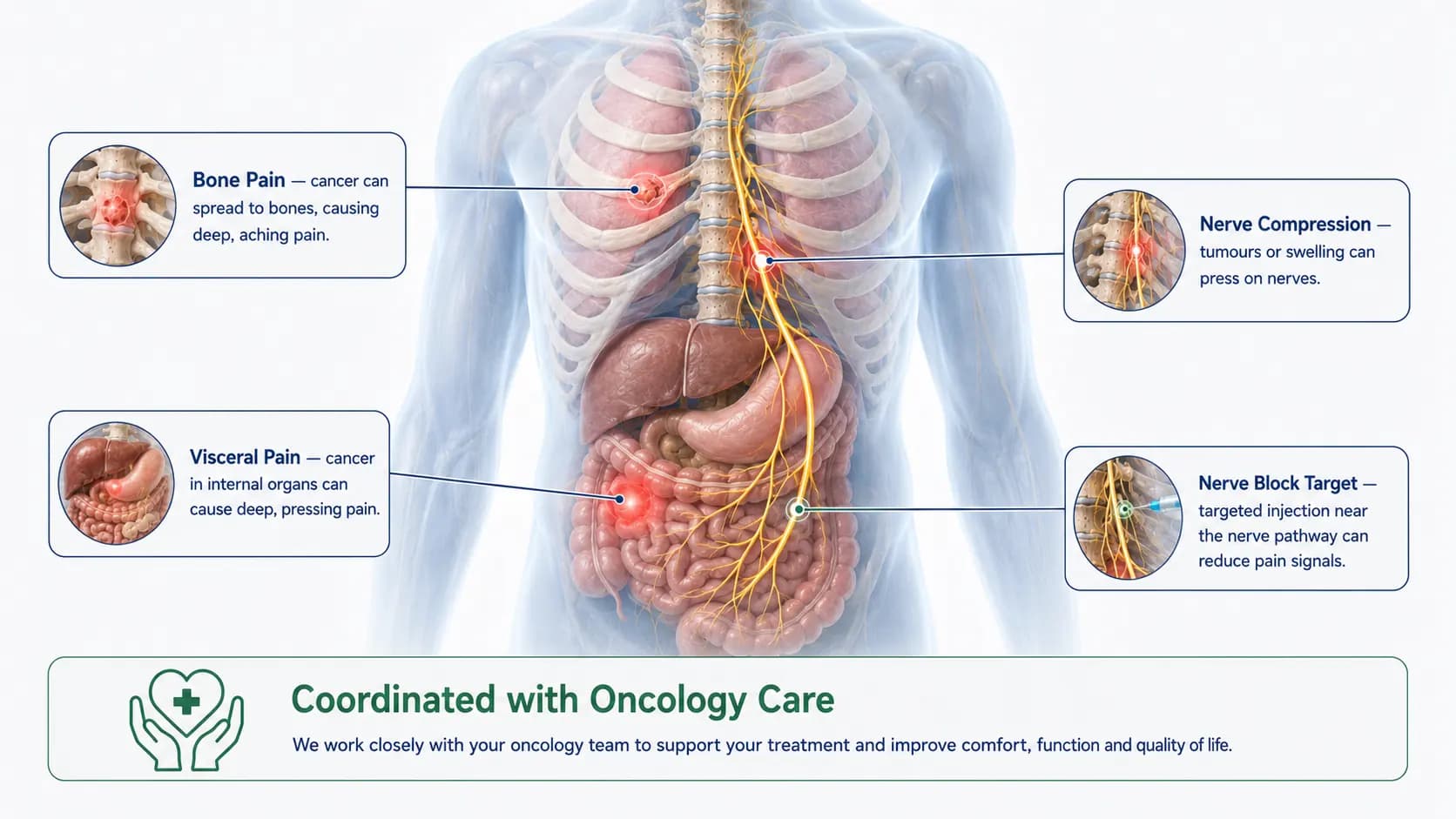
Cancer-related pain is complex and can have multiple causes: direct pressure or invasion from a tumor, spread to other areas of the body, damage from chemotherapy affecting nerves, burns or irritation from radiation, or pain at surgical sites. Each pattern requires specific evaluation to understand what is driving it.
Pain management is a core part of cancer care, not a replacement for your cancer treatment. When pain is well-controlled, you can tolerate your oncologic therapy better, stay active, sleep, and focus on what matters most to you. Working closely with your oncology team ensures our pain strategies support your overall treatment.
Interventional pain care can be particularly effective for cancer pain — especially pain from nerve irritation, chest wall involvement, or specific surgical effects. Many patients gain relief that meaningfully improves their daily function and quality of life.
Cancer pain can worsen quickly, and certain patterns signal the need for urgent evaluation.
- Sudden new pain that is severe or rapidly worsening
- Pain with weakness or numbness spreading to your leg or arm (possible spinal cord involvement)
- Loss of bowel or bladder control with pain
- Pain with high fever, chills, or other signs of infection
What patients usually describe
- Constant or intermittent pain at the tumor site
- Pain from metastatic disease
- Burning, tingling, or numbness from chemotherapy
- Soreness or restricted movement at surgical sites
- Chest wall or rib pain from radiation
- Muscle weakness, cramping, or loss of function
- Sleep disruption and fatigue from uncontrolled pain
What we look for in evaluation
- Direct invasion or compression from a tumor
- Metastatic disease affecting bone or soft tissue
- Chemotherapy-induced peripheral neuropathy
- Radiation therapy affecting nerves or soft tissue
- Surgical wound or nerve injury from cancer surgery
- Muscle tension and guarding in response to pain
Diagnosis comes before any procedure.
We assess the character, location, and pattern of your pain, then review your cancer diagnosis, tumor location, treatments received, and surgical history. This context shapes the evaluation. We coordinate with your oncology team and review imaging. Understanding what is causing the pain leads to precise treatment.
Detailed pain evaluation — where it is, how it feels, what makes it better or worse, and how it affects your daily life.
Review your cancer stage, treatment plan, and recent imaging with you and your oncology team to align on the cause.
Design a pain management approach that works alongside your cancer care and realistic recovery goals.
Treatments we offer for cancer-related pain
Each option below is matched to a confirmed pain generator. We start with the least invasive effective approach and only escalate when the diagnosis supports it.
Your first appointment
Expect a thorough evaluation that takes your cancer history seriously. You'll leave with a clear understanding of what we think is causing your pain, how we plan to treat it, and how it fits with your cancer care. We communicate directly with your oncology team.
What recovery typically looks like
Cancer pain management is an ongoing process that adapts as your cancer care changes. Many patients experience significant relief that lets them stay active, sleep better, and focus on their treatment and recovery. Pain control is not your only goal — quality of life is.
Conditions patients with cancer-related pain often ask about
Questions about cancer-related pain
Will your pain treatment interfere with my cancer care?
No. Our goal is to coordinate directly with your oncology team. Pain management supports your ability to tolerate your cancer treatment and maintain quality of life. We are a partner in your care, not separate from it.
What if I'm already on pain medication?
We work with your oncology team and all your providers. If you are taking opioids or other medications, we discuss those openly and coordinate changes only when it strengthens your overall pain plan.
Can interventional treatment help with chemotherapy neuropathy?
Yes. Nerve blocks and other injections can reduce the burning and numbness that chemo sometimes causes. This is one area where interventional care can be very effective.
Ready to find the source of your pain?
Share a few details and our team will reach out to confirm a time that works with your schedule and your insurance.
Request an appointment
Tell us about your cancer-related pain symptoms and preferred clinic. We will confirm the next available appointment options.