Bursitis and Tendonitis
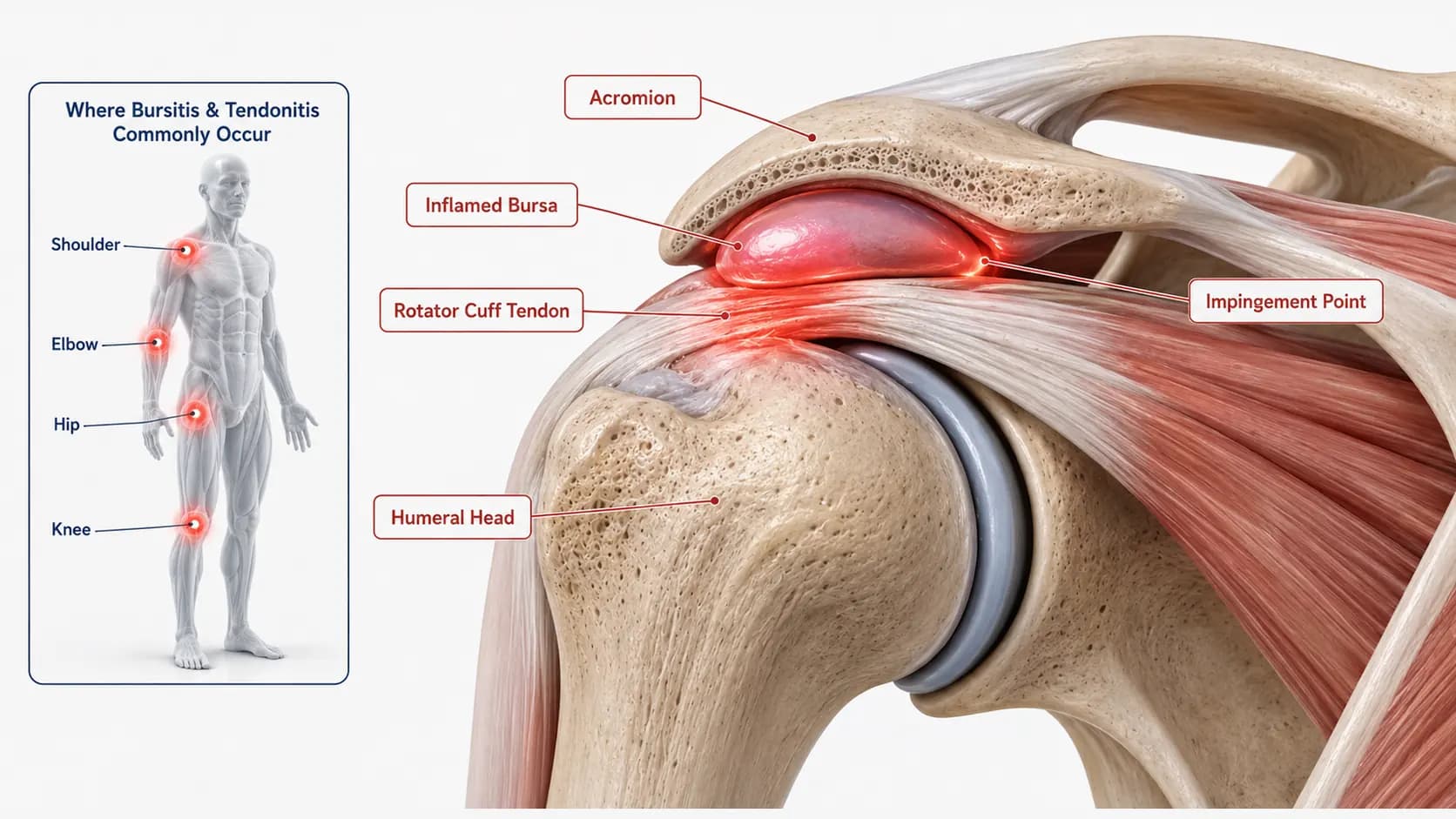
Bursitis and tendonitis are painful inflammation of the fluid sacs and tendons that stabilize your joints, most commonly affecting the shoulder, hip, elbow, and knee.
Image-guided injections paired with targeted rehabilitation address inflammation and restore pain-free function without surgery.
Diagnosis-first care for bursitis and tendonitis
Physician-led evaluation, image-guided procedures when indicated, and insurance-friendly scheduling across three Houston-area clinics.
Understanding bursitis and tendonitis
Bursitis is inflammation of a bursa — a fluid-filled sac that cushions and reduces friction between bones, tendons, and muscles around a joint. Tendonitis is inflammation or irritation of a tendon, the fibrous tissue connecting muscle to bone. While related, they affect different structures and can occur together or independently, each requiring thoughtful treatment.
Common sites include the shoulder (subacromial bursitis and rotator cuff tendinopathy), hip (greater trochanteric pain syndrome), elbow (olecranon bursitis and lateral or medial epicondylitis), and knee (prepatellar bursitis and patellar tendinopathy). Many chronic cases reflect tendinopathy — degeneration and microtrauma of tendon tissue — rather than pure inflammation. This distinction matters because it affects how treatment is planned and what rehabilitation is needed.
The condition often stems from repetitive activity, direct pressure, or overuse but can follow an acute injury. Most cases improve with anti-inflammatory care, activity modification, and rehabilitation, though persistent symptoms benefit from targeted interventional evaluation to reduce pain and restore motion.
Most bursitis and tendonitis improve with time and conservative care, but certain findings warrant prompt evaluation.
- Pain that wakes you most nights despite ice and rest
- Significant loss of strength or motion limiting daily function
- Swelling that worsens despite ice, rest, and over-the-counter anti-inflammatories
- Symptoms lasting more than three to four weeks without improvement
What patients usually describe
- Localized pain and swelling over the affected joint
- Pain worse with movement in specific directions
- Stiffness, especially after rest or sleep
- Weakness or difficulty performing activities that stress the joint
- Pain that wakes you at night or worsens with certain movements
- Mild warmth or redness over the affected area
- Gradual loss of motion if symptoms persist
What we look for in evaluation
- Repetitive overhead activities or sports
- Direct pressure or blunt trauma to the joint
- Overuse or sudden increase in activity level
- Poor biomechanics or muscle imbalance
- Occupational demands requiring sustained gripping or lifting
- Age-related changes in tendon elasticity and tissue resilience
Diagnosis comes before any procedure.
The exam assesses strength, range of motion, and movements that reproduce pain. Ultrasound or MRI confirms the diagnosis and pinpoints the exact structure involved — bursa inflammation, tendon irritation, or both. This anatomic precision guides where treatment is directed for best results.
Physical exam testing strength, motion, and pain-producing movements to identify the involved structure.
Ultrasound or MRI to confirm inflammation and localize the problem for targeted treatment.
Injection paired with rehabilitation addressing both inflammation and the mechanics that caused it.
Treatments we offer for bursitis and tendonitis
Each option below is matched to a confirmed pain generator. We start with the least invasive effective approach and only escalate when the diagnosis supports it.
Your first appointment
Expect a focused exam identifying which structure is inflamed and contributing to your pain. Most patients leave with a clear diagnosis and a working plan combining injection with rehabilitation exercises to restore full function.
What recovery typically looks like
Pain typically improves over two to four weeks with anti-inflammatory care and activity modification. Injections can accelerate this timeline, but lasting improvement requires rehabilitation exercises to correct the mechanics or activity pattern that caused the problem.
Conditions patients with bursitis and tendonitis often ask about
Questions about bursitis and tendonitis
Will an injection cure my bursitis or tendonitis?
Injections reduce inflammation and pain substantially, but lasting recovery requires rehabilitation and activity modification to address what caused the problem initially.
How long before I can return to normal activities?
Most patients notice significant improvement within two to four weeks. Full return to demanding activities usually takes longer and depends on completing rehabilitation exercises.
Can bursitis or tendonitis come back?
Yes, if the activity or biomechanics that caused it persist without change. Rehabilitation and activity modification are essential to prevent recurrence.
Ready to find the source of your pain?
Share a few details and our team will reach out to confirm a time that works with your schedule and your insurance.
Request an appointment
Tell us about your bursitis and tendonitis symptoms and preferred clinic. We will confirm the next available appointment options.