Degenerative Disc Disease
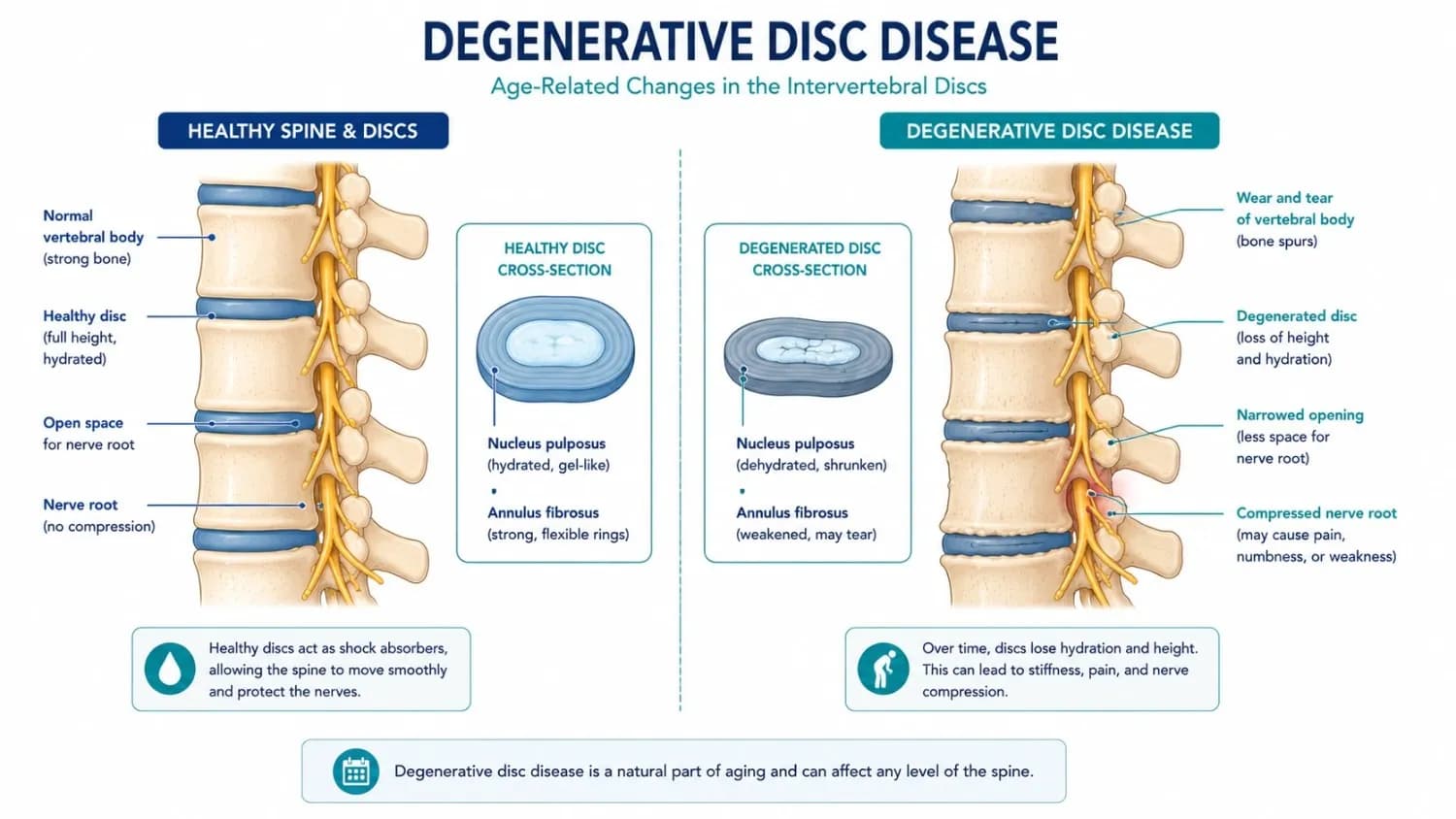
Degenerative disc disease describes the age-related changes that reduce a disc's ability to absorb load, often producing stiffness, aching, or episodic flares of pain.
Despite the name, disc degeneration is common and not always painful. Our evaluation identifies whether the disc is the actual generator of your symptoms.
Diagnosis-first care for degenerative disc disease
Physician-led evaluation, image-guided procedures when indicated, and insurance-friendly scheduling across three Houston-area clinics.
Understanding degenerative disc disease
Discs lose water content and elasticity over time. These changes are visible on imaging in most adults by middle age and are often unrelated to symptoms. Degenerative disc disease becomes a clinical problem when the changes drive pain — typically a deep, axial ache with episodic flares — or contribute to disc bulging and nerve irritation.
Patients often describe pain that worsens with prolonged sitting, lifting, or forward bending, with stiffness in the morning that loosens through the day. Flares may be triggered by activity but can also occur without obvious cause.
Our evaluation distinguishes painful disc degeneration from incidental imaging findings, so treatment is targeted at the structure actually producing pain.
Most degenerative disc pain is manageable, but some patterns warrant earlier evaluation.
- Progressive weakness or numbness
- Frequent flares that interfere with work or sleep
- New radiating pain into a leg or arm
- Bowel or bladder symptoms
What patients usually describe
- Deep, axial back or neck ache
- Stiffness that is worse in the morning
- Pain worse with sitting and forward bending
- Episodic flares lasting days to weeks
- Reduced tolerance for sustained posture
- Occasional radiating pain into the buttock or shoulder
- Pain relief with frequent position change
What we look for in evaluation
- Age-related loss of disc hydration
- Repetitive load and lifting history
- Genetic predisposition
- Smoking and metabolic factors
- Prior trauma or injury
- Postural overload
Diagnosis comes before any procedure.
We use a focused exam to distinguish disc-mediated pain from facet, sacroiliac, or muscular contributors. Imaging findings are interpreted in light of the exam, since disc changes are common in pain-free adults. Diagnostic injections may be used selectively to confirm a disc or adjacent structure as the source.
Pattern history, exam, imaging interpretation in clinical context.
Selective injections when the dominant source is unclear.
Conditioning-forward plan with interventions for flares.
Treatments we offer for degenerative disc disease
Each option below is matched to a confirmed pain generator. We start with the least invasive effective approach and only escalate when the diagnosis supports it.
Your first appointment
The first visit emphasizes interpretation of imaging findings against a careful exam. Most patients leave with a working diagnosis and a plan that combines conditioning with selective interventional care for flares.
What recovery typically looks like
Degenerative disc disease is best framed as a long-term condition with manageable flares. Most patients maintain good function with conditioning, ergonomic adjustments, and periodic interventional support.
Conditions patients with degenerative disc disease often ask about
Questions about degenerative disc disease
Is degenerative disc disease really a disease?
The name is a misnomer. Disc degeneration is a normal age-related process that is sometimes — not always — a source of pain.
Will it keep getting worse?
Not necessarily. Many patients stabilize and maintain function for years with conditioning and selective interventional care.
Is exercise safe?
Yes, and often essential. The right exercises depend on the level and pattern of symptoms, which we discuss at your visit.
Ready to find the source of your pain?
Share a few details and our team will reach out to confirm a time that works with your schedule and your insurance.
Request an appointment
Tell us about your degenerative disc disease symptoms and preferred clinic. We will confirm the next available appointment options.